
Comments on LinkedIn and your personal brand
Do you leave comments on LinkedIn posts?
Many people do not. They scroll on LinkedIn. They read posts. They may leave a ‘like’ reaction. But that is as far as it goes in terms of activity.
Writing comments on LinkedIn posts can make a huge difference to your profile being noticed. Changes to the LinkedIn algorithm have indicated that commenting is regarded as highly favourable to your visibility on the platform.
Writing comments on LinkedIn posts can make a huge difference to your profile being noticed. Changes to the LinkedIn algorithm have indicated that commenting is regarded as highly favourable to your visibility on the platform.
LinkedIn started showing impressions on comments in the last year. Impressions is the number of people who have seen your comment. LinkedIn’s 360Brew algorithm, which was introduced in 2025, has changed how your profile appears on LinkedIn when you comment to show the number of impressions.
This comment has had 979 impressions so far. I accept it is an emotive comment.
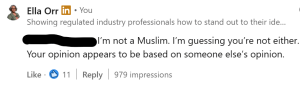
Not only are the impressions shown but a person can take action after reading your comment by following you.
Do you look at your analytics which are underneath the top card which shows your headline?
If you tap on Search appearances, you’ll see Profile appearances and where you appeared during the previous week. You can get some useful data about the instances where your name and headline appear across LinkedIn.
The analytics are a bit limited if you are on a free account with basic view counts and limited visitor information, but you should still get some insights.
Here’s mine from the end of July 2026.

These stats are useful as they show that my comments are leading to visibility. LinkedIn is prioritising comments, so this is a great opportunity if you are looking for more people to find you on the platform.
Why do comments make a difference?
Think of your comment as a response to a conversation starter i.e. the original post. Your comment is your thoughts and opinions as you would give if you were talking to someone in person.
If the person who has posted already knows you, then commenting on what they’ve written will build familiarity with you. If the poster is someone outside of your network, think of your comment as a way of you introducing yourself into their world.
How to write comments which get you noticed
The ‘thanks for sharing’ or ‘great post’ comments, whilst being complimentary, don’t tell the person who wrote the post or other readers anything about you. So not just any comment will do. Try to make it a comment that is worth reading.
You can give more insight into your personal brand with comments which say show your personality. Try to write something which leads to a response from the poster or other commenters. Meaningful comments can lead to conversations on the public feed.
A comment which shows your knowledge or expertise is an effective way to signpost someone to view your profile. If you are sharing your insights and expertise and that is reflected in what is written in your profile, someone is much more likely to take an action as a result. They may follow you. They may send you a connection request. They may tap the notification bell on your profile, so they know when you post.
An opportunity to show you are human
Over the years LinkedIn has become much more than a platform for recruitment and business updates as you know. It’s an online meeting place for people to discuss of variety of topics. Many LinkedIn traditionalists may not like this and there’s always those who protest ‘This isn’t Facebook!’
Despite the march of AI and automation, we still want human conversations in the world of work and business.
You can use your comments to get involved on posts. You may agree with what’s written or want to show a different perspective. Share your point of view in a comment, especially if you wish to show allyship with the post writer.
If they have a strong network, then you may find that their connections take an interest in what you have to say.
Alternatively, you may even feel you want to disagree which is, of course, a bolder move. My advice is not to be controversial. Remember anything you write in a comment will reflect your personal brand.
Sometimes people ask for advice in a post. If you can comment with useful and helpful feedback, it is a good sign that you are ready to offer solutions. Remember how part of your personal brand is to show people the problem you can solve or pain point you can address for them.
Working out what to comment on
The quality of posts in your feed may not be that good. Let’s face it, many posts are not worth commenting on. It is likely you’ll need to do some scrolling before you find a suitable post that inspires you to comment.
If you want your feed to match your interests, then you should aim to signal to LinkedIn what you want to see. You can do this by searching for topics and industry-focused subjects, and reacting to posts on these which lets the algorithm know you are interested.
Also, if you want to see the posts of 1st degree connections, then make sure you tap their notification bell and leave comments.
Giving thought to why you are commenting
Now more prominence is being given to comments, be aware that people you work with and know will see your comments. So it is important to keep in mind the thoughts and opinions you are sharing.
Before commenting, ask yourself: “Would my network find value in this conversation?” If it’s a post which directly relates to what you do, then this could be an opportunity show your knowledge and expertise.
If it’s a post which is about a news item or an issue you support, then thoughtful commenting will shine a light on your personality and values. If you add value in any kind of way, then you are more likely to have people liking your comment or even better having a glance at your profile.
Commenting on the post of people you already know (1st degree connections) is a safe option. After all, you will have connected with them for a reason, so what they write about is much more likely to be on interest to you.
Here’s something else that is worth trying. Comment on posts that your connections comment on.
▶ When you see ‘…. commented’, stop scrolling and have a look at the post that your connection commented on.
▶ Read the post. Can you see why your connection commented on it?
▶ Read your connection’s comment.
▶ Can you add something to the comments on the post? The chances are you will be able to because the post interested one of your connections.
This is so simple, but it works.
Write as yourself
Try to use your own words and voice. Of course AI tools can write comments for you, but I would not recommend using them in the first instance. Your authenticity is what makes people want to connect with you. If you want your personal brand to speak for you, then get comfortable with commenting as you.
AI may feel like a more efficient, time saving way to comment but it is better to leave fewer comments which are thought through and genuine rather than a string of generic or AI generated ones.
Find a consistent pattern to how often you comment. It has to suit you so it can become a habit. Whether that’s three times a week or once a day, find a cadence you can maintain. It’s the consistency that builds relationships, not a numbers game.
If you are finding it difficult to create a consistent habit for posting or you don’t have the time, then it’s worth setting aside a regular weekly slot in your diary to focus on thoughtful commenting.
You can demonstrate your expertise and be noticed without the pressure of creating posts.
Think about how commenting as part of your personal brand could get you in front of your target audience and lead to more people wanting to work with you.
Would you like to know more about how to start working on your personal brand?
Take a look at this opportunity to work with me for half a day – the Personal Brand Launchpad
I’m keen to help more professionals working in regulated industries use personal branding effectively to attract their ideal clients.
Drop me a message here and let’s have an introductory chat.